







MY POV

Perspectives On Healing

A collection of perspectives shaped by lived experience, clinical training, and the people who continue to teach me what healing can look like.

Identity-Affirming Care

Gender-Affirming Care is Relational

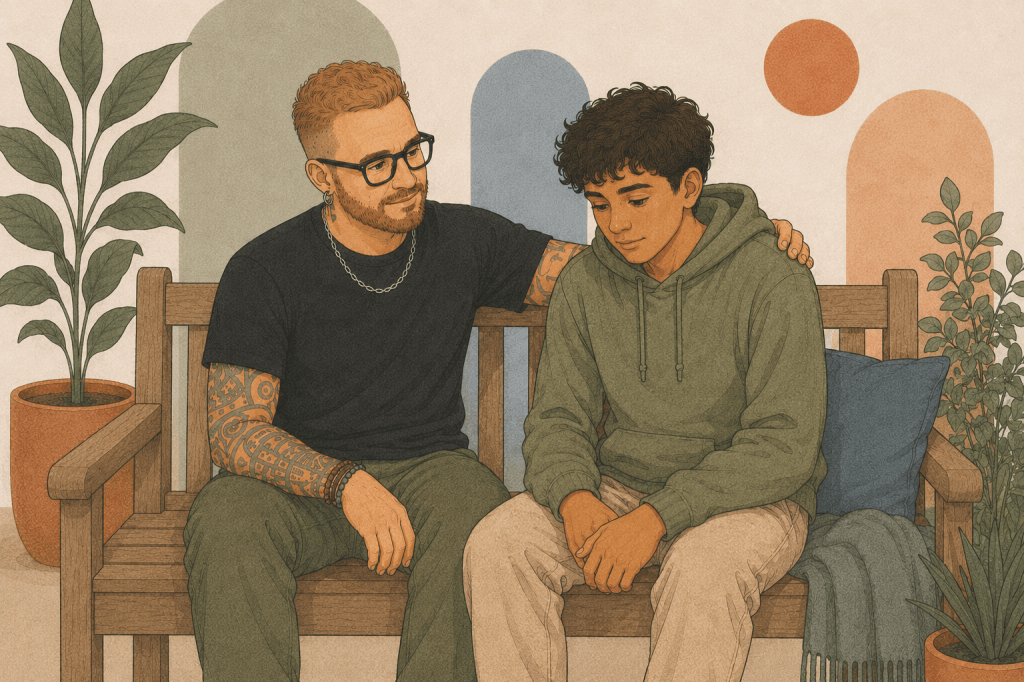
Identity doesn’t develop in isolation, and neither does healing. Gender-affirming care is fundamentally relational, recognizing that who we become is shaped through our relationships with ourselves, others, and the world around us

The model

Gender-affirming care is relational care, and it moves toward self-worth.

Six domains hold the same person at once, from the work we do with ourselves to the systems around us. Together they rebuild a stable, self-compassionate sense of self.

Development

Our earliest relationships shape how we come to know ourselves.

Our sense of self develops through early relationships, lived experiences, and the messages we receive about who we’re allowed to be. Understanding these patterns helps us make sense of the beliefs we carry today.

Repair

Healing begins by changing the relationship with ourselves.

Relational wounds often become beliefs about being wrong, too much, or unworthy. Through inner child work, reparenting, and self-compassion, repair helps build a more stable and authentic sense of self.

Therapeutic Relationship

The therapeutic relationship as a corrective experience.

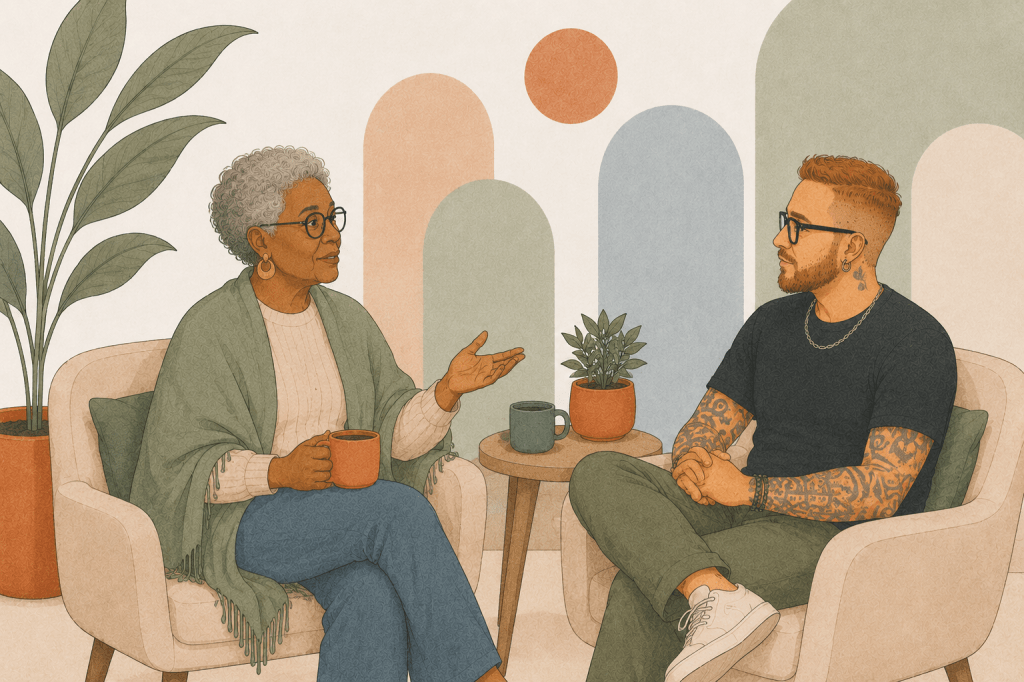
An affirming therapeutic relationship offers a new experience of being seen, understood, and accepted. Over time, that relationship can help reshape the patterns that once formed in the absence of safety and connection.

Community

Connection is a form of care, not just companionship.

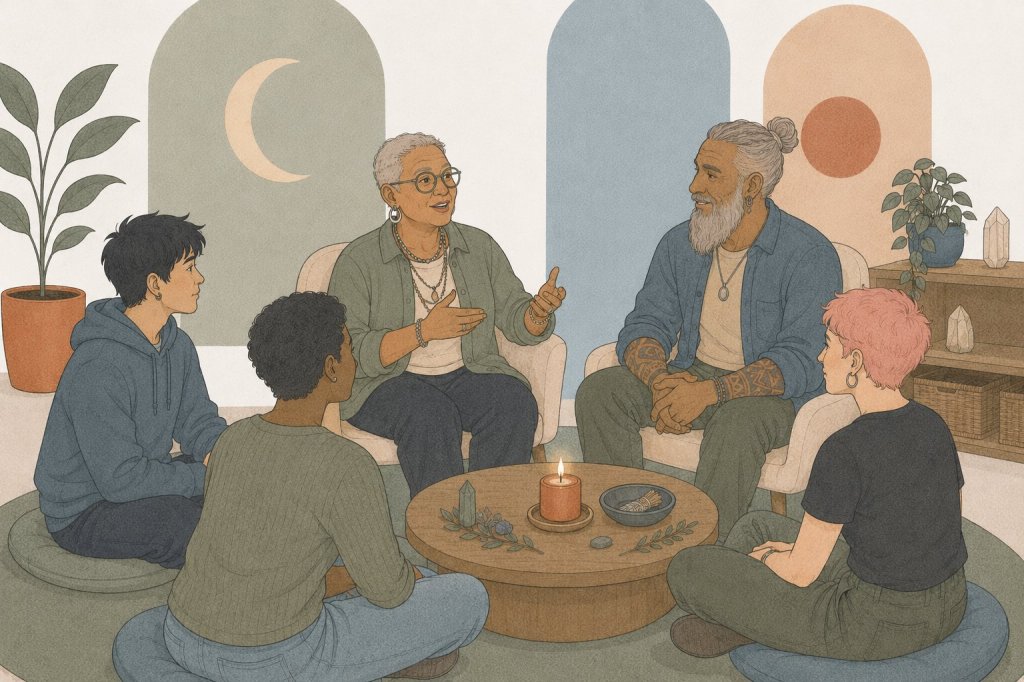
Connection with peers, chosen family, and affirming communities creates belonging where isolation once existed. Healing deepens when our identity is witnessed, supported, and celebrated with others.

Queer Care Traditions

We inherit generations of care, not just generations of struggle.

LGBTQ+ communities have always had ways to care for one another when families, healthcare, and institutions failed to do so. Through chosen family, mutual aid, and community-born care, we inherit generations of wisdom that continue to shape healing today.

Advocacy

Care challenges the systems, not just the symptoms.

The distress people carry is systemic, not only personal. Grounded in Just Practice, Liberation Health, and queer care traditions, advocacy becomes part of treatment because healing also means changing the conditions that cause harm.

Self-worth

Everything changes when our inner voice becomes an ally.

Gender-affirming care is about more than reducing distress. It helps transform our relationship with ourselves so self-worth, rather than shame, becomes the foundation for everything that follows.

Self Psychology

Childhood Development: Three Core Needs

When children develop their sense of self, Self Psychology identifies three essential needs: Mirroring, Twinship, and Idealization. Too often, queer and trans children are denied these affirming experiences, resulting in the low self-esteem and poor mental health.

Mirroring

Affirmation and encouragement that helps a young person feel seen, valued, and emotionally understood. When denied at home, TGNC youth learn that the self they know is not one they can show.

Twinship

The experience of sameness, belonging, and not feeling alone in who you are. Without it, TGNC youth conceal and monitor safety constantly, and anticipating disbelief becomes its own daily labor.

Idealization

Connection to a healthy adult that is experienced as safe, admired, or aspirational. Queer and trans youth have few role models to look toward as evidence of a future available to them.

Fragmented

Forming

Cohesive

The self

Select a need to see what it holds.

Partly held. A self can carry one or two, but the gap stays open.

All three met, self-esteem forms.

Recognition is the intervention

Kohut, 1977 · Miliora, 2000 · Wright, 2021

Guiding the work

The Circle of Secure Attachment

Secure attachment is not a fixed trait we either have or we don’t. It is a rhythm we live inside, the confidence to go out, the safety to come back, and a little more resilience each time around.

One continuous cycle

A path we keep returning to

A secure relationship gives us two things at once: a steady base to explore from, and a haven safe enough to return to. We move through this cycle again and again across a life, and it heals through repetition. Tap any stage to explore it.

The secure relationship

Secure Base & Safe Haven

At the center is a relationship that holds both ends, someone who sends us outward and stays a place to come back to for comfort and repair. It might be a therapist, a partner, a caregiver, a community, and in time, our own steady sense of safety.

Setting out

Supporting Exploration

With someone secure behind us, curiosity becomes possible. We try, we risk, and we take up space, trusting it is safe to venture out because we know where home is. Exploring is not the opposite of connection, it is what connection frees us to do.

Out in the world

Watching Over & Enjoying Together

The secure relationship stays available from a distance, watching over without hovering, and delighting in what we find. Being enjoyed, not only tolerated, is its own kind of safety, and it tells us we are worth returning to when we come back in.

Coming back

Welcoming the Return

When something gets bigger than we can hold alone, we come back, and we are met without shame. Returning is not a failure of independence, it is the design working, the same relationship that sent us out now steady enough to receive us again.

Comfort and repair

Protect, Comfort, Accept Feelings

Here we are protected, helped to name what we feel, and allowed to feel it. Every relationship misses sometimes, and trust is built less by avoiding the misses than by the repair that follows. Enough of these, and the system settles toward trust.

inner child work

Rewriting The Code We were Given

From birth, our families, culture, and systems shape the beliefs we carry about ourselves and the world. We inherit a broken code, and those messages form the operating system beneath our thoughts, relationships, and choices. By returning to where those patterns began, we can meet unmet needs and begin writing a different future.

What’s showing up now

Showing Up Now

Overly strong reactions that feel bigger than the moment.

What's Really Happening

Your nervous system is responding to earlier emotional patterns that learned to protect you.

How Inner Child Work Helps

Therapy helps you understand why these reactions exist.

What Starts To Change

Reactions feel less intense and don't take over your whole body.

Showing Up Now

Anxiety or people-pleasing in your relationships.

What's Really Happening

Early experiences shaped how safe it feels to need or disappoint others.

How Inner Child Work Helps

You learn to notice relational triggers and respond with more awareness.

What Starts To Change

Less urgency to fix, explain, or manage other people.

Showing Up Now

Shutting down, numbing, or pulling away.

What's Really Happening

Your body learned withdrawal to cope with stress.

How Inner Child Work Helps

Inner child work tracks what pulls you offline, and gently interrupts it.

What Starts To Change

You stay present longer instead of disappearing.

Showing Up Now

Chronic self-criticism or shame.

What's Really Happening

Internalized messages from early experiences are still running.

How Inner Child Work Helps

Inner child work meets the harsh inner voice with compassion.

What Starts To Change

The inner critic quiets, and self-worth stops hinging on performance.

Showing Up Now

Feeling younger during conflict or stress.

What's Really Happening

Certain situations activate younger nervous-system states.

How Inner Child Work Helps

Inner child work brings awareness to those states as they surface.

What Starts To Change

More self-compassion, and less self-blame.

Showing Up Now

Difficulty trusting safety or calm.

What's Really Happening

Your system learned that safety was inconsistent or short-lived.

How Inner Child Work Helps

Healing helps your body experience safety in real time.

What Starts To Change

Calm starts to feel neutral instead of unfamiliar.

Spirituality & Healing

The Search for Meaning

Our beliefs and values shape how we see ourselves, connect with others, and make sense of life’s experiences. Whether through faith, spirituality, or personal philosophy, they influence how we navigate both joy and hardship.

Is spirituality the same as religion?

For some, spirituality is found in religion. For others, it’s found in nature, creativity, or quiet reflection. Whatever form it takes, it offers a way to feel grounded and make meaning of life’s biggest questions.

How did I find mine?

Recovery transformed my understanding of spirituality. What began as surrender grew into a relationship with nature, interconnectedness, and trust that we’re part of something larger than ourselves. That perspective doesn’t require shared beliefs, only respect for the many ways people find meaning.

Will spirituality be part of our work?

My role isn’t to guide your beliefs, but to understand how they shape your life and whether they can be a source of strength, healing, or resilience. It’s always an invitation, never an expectation.

The Canary Code Framework

Embedding Inclusion Across the Employee Experience

Explore Ludmila N. Praslova’s Canary Code to see how six guiding principles and twelve talent practices work together to create more inclusive, equitable workplaces.

Removing Success Barriers

Realistic Job Descriptions

Base job descriptions on actual responsibilities and essential skills, removing unnecessary barriers before hiring begins.

Removing Success Barriers

Inclusive Recruitment

Broaden recruitment efforts to attract talented candidates from diverse backgrounds and lived experiences.

Removing Success Barriers

Valid, Outcomes-Focused Selection

Use hiring methods that measure the ability to do the job, not subjective impressions or outdated expectations.

Removing Success Barriers

Fair Compensation & Viable Part-Time Options

Create equitable pay practices and flexible employment options that support different needs and career paths.

Removing Success Barriers

Benefit Options for Different Needs & Family Status

Offer benefits that reflect the diverse realities of employees’ identities, families, and caregiving responsibilities.

Removing Success Barriers

Training in Multiple Modalities & Intersectional Inclusion

Deliver learning in accessible ways while building understanding across identities, experiences, and perspectives.

Removing Success Barriers

Health-Supportive Physical Work Environments

Design work environments that support employees’ physical, sensory, and psychological well-being.

Removing Access Barriers

Flexible Work & Job Crafting

Provide flexibility in where, when, and how work happens while allowing roles to align with individual strengths.

Removing Access Barriers

Civility & Anti-Bullying Mechanisms

Create respectful workplaces with clear expectations, accountability, and support for addressing harmful behavior.

Removing Access Barriers

Fair, Outcomes-Based Performance Measurement

Measure performance by meaningful outcomes rather than visibility, work style, or subjective perceptions.

Removing Access Barriers

Fair, De-Biased & Transparent Promotion

Make advancement decisions using clear, equitable criteria that give every employee a fair opportunity to grow.

Removing Access Barriers

Representation in Leadership & Decision-Making

Build representation into leadership and decision-making, so those affected by choices have a real voice in making them.

Case Study · Evan

Ethical Dilemmas in Gender-Affirming Care

This case explores how gender identity, family relationships, and social systems shape a young person’s developing sense of self, and how affirmation can become a protective force.

01 / 0802 / 0803 / 0804 / 0805 / 0806 / 0807 / 0808 / 08
Ethical Dilemmas in Gender-Affirming Care (title)
Evan, case study quote
Meet Evan, clinical picture
Cultural transphobia at every level
Three ruptures, one repair
What the work looked like
The work was to see him
Group exercise, discussion questions
Case study slide 1
Case study slide 2
Case study slide 3
Case study slide 4
Case study slide 5
Case study slide 6
Case study slide 7
Case study slide 8

Case Study · Ivan

Ethical Dilemmas in Gender-Affirming Care

Ivan’s story illustrates how chronic trauma, family systems, culture, and identity intersect during adolescence, shaping not only how a young person survives, but how they come to understand themselves.

01 / 0802 / 0803 / 0804 / 0805 / 0806 / 0807 / 0808 / 08

My Approach

The CARE Framework

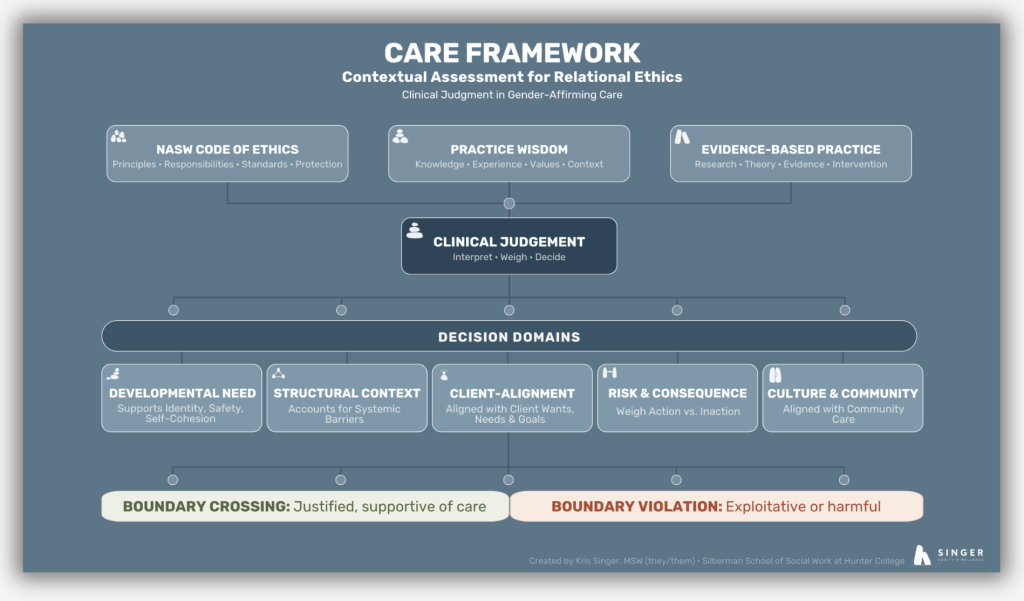
The Contextual Assessment for Relational Ethics (CARE) Framework is a tool I built to help navigate clinical judgment when a situation is genuinely in tension and there is no clean answer.

Start anywhere
Read the cairn, stone by stone
Every stone is weighed for the whole to hold. Select any one to see how it shapes an ethical, affirming decision.
Foundations
NASW Code of Ethics
The professional floor. Every choice stays accountable to the NASW Code of Ethics, its principles, standards, and the protections owed to a client.
Foundations
Practice Wisdom
What I carry into the room: accumulated clinical knowledge, lived experience, and the values that shape how I show up.
Foundations
Evidence-Based
Current research, sound theory, and interventions with real support keep the work anchored in more than instinct.
Keystone
Clinical Judgment
The keystone. Foundations do not decide for me; they inform the judgment I make, interpreting the situation, weighing what matters, and deciding with care.
Decision domain
Developmental Need
Where is this client developmentally, and what does their identity, safety, and cohesive sense of self ask for right now?
Decision domain
Structural Context
The systems around the client: barriers, access, and the structural realities that shape what is actually possible.
Decision domain
Client Alignment
What the client actually wants, needs, and is working toward, held as central rather than assumed.
Decision domain
Risk & Consequence
Both sides of the ledger: the risks of acting, and the equally real risks of doing nothing.
Decision domain
Culture & Community
The client’s culture and community, and whether the plan honors community-based, affirming care.
Explore the framework →

Thinking out Loud (and Proud)

Resources for Every Stage of the Journey

Whether you’re a young person, caregiver, educator, or clinician, these resources are designed to help you find support, understanding, and next steps.

Individuals

Resources for individuals exploring identity, seeking affirming support, and finding their own path toward wellbeing and understanding.

Explore Resources →

Youth, Families & Schools

Resources for youth, families, and schools navigating mental health, identity, and belonging with affirming support and community care.

Explore Resources →

Clinicians & Organizations

Resources for clinicians and educators building affirming, identity-centered practice from clinical frameworks to continuing education.

Explore Resources →

Whenever you’re ready, I’m here.

(646) 598-2216 · singerwellness@gmail.com