
Introduction
A fourteen-year-old I’ll call Evan sits across from me, struggling through tears to find his words. Like so many transgender and gender nonconforming (TGNC) young people, he is carrying depression, anxiety, and disordered eating that are all braided together with gender dysphoria. After a hospitalization for low body weight, he entered an eating disorder recovery program, until a physician mentioned gender-affirming care and his parents pulled him out. Now puberty is progressing, his chest is developing, and his food restriction is intensifying. After a long silence, he finally gathers the courage to ask me one thing: “Would you be willing to get me a chest binder?”
He is asking for a simple piece of cloth. If he identified with the sex he was assigned at birth, something similar, a sports bra, might be handed to him without a second thought. And yet, in this context, the request becomes ethically and institutionally complex. Every instinct in me says yes, of course. And every risk-averse reflex I absorbed in my training says be careful, this could be seen as crossing a line.
That moment is where the CARE Framework began.
When the rulebook doesn’t fit the room
Social work ethics tend to prize neutrality, clear role boundaries, and the avoidance of dual relationships. Those norms exist for good reasons; they protect clients from exploitation and harm. But the version of “boundaries” most of us are trained into was shaped in the 1980s by a wave of litigation and liability anxiety across the helping professions. It often frames ethical practice as a matter of maintaining distance, of not “crossing the line,” not “blurring boundaries,” staying the objective expert on the far side of the desk.
For TGNC youth, that framing can quietly fail the people it’s meant to protect. These young people face dramatically elevated rates of depression, suicidality, family rejection, and housing instability, not because anything is wrong with them, but because cultural transphobia operates at every level of their world, from the home to the school to state and federal policy. What they are living through is, at its core, a chronic deprivation of recognition, affirmation, and belonging. And a model of care built on distance has very little to offer a young person whose central injury is being unseen.
Care has always been relational
Here is the thing the standard boundary model tends to forget: queer and trans communities have never waited for institutions to take care of us. When families, schools, clinics, and governments failed, we built our own systems, including chosen family, ballroom houses led by trans “mothers” and “fathers,” intergenerational networks of eldership, and mutual aid that moves clothing, housing, and even gender-affirming medical resources between people who understand that care has to be collectively generated.
Developmental theory helps explain why this matters so much. Heinz Kohut’s Self Psychology describes how a cohesive sense of self forms through what he called selfobject experiences: being mirrored (validated for who you are), having someone to idealize (a stable figure to look up to), and twinship (the felt sense that you are not alone, that someone like you exists). For many TGNC youth, those experiences are missing or actively withheld at home. Affirming adults, whether a teacher, a clinician, or an older member of the community, can step in and offer exactly those functions. When they do, the effect isn’t just supportive; it can be reparative and, the research suggests, lifesaving.
This is why the tension in Evan’s request is so sharp. Refusing him in the name of “boundaries” doesn’t just deny a piece of cloth. It reenacts the very failure of recognition that is harming him.
Crossings are not violations
Decades ago, Kagle and Giebelhausen drew a distinction that quietly reorganizes this whole conversation: the difference between a boundary violation and a boundary crossing.
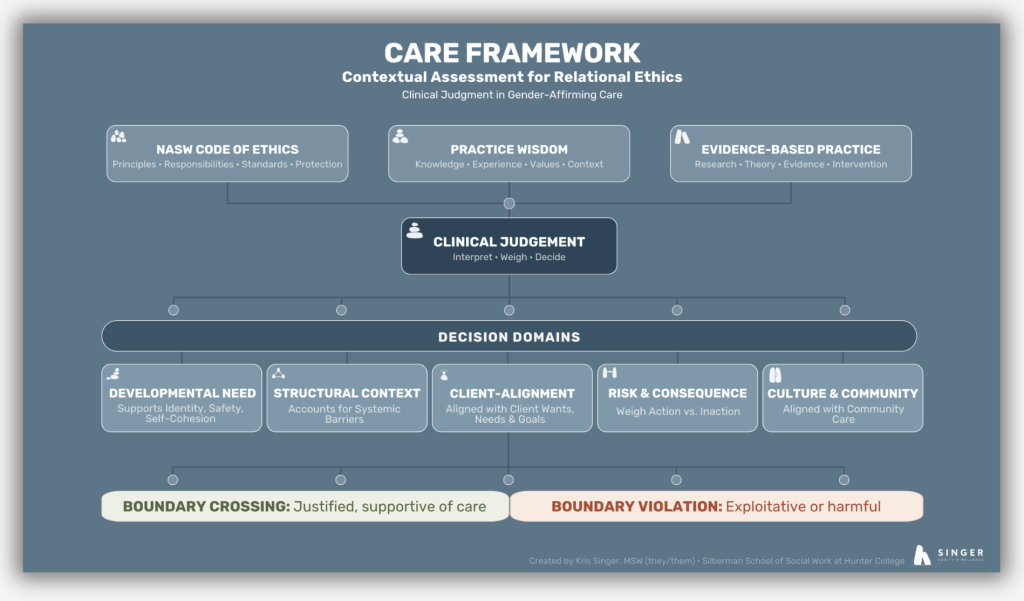
A boundary violation is exploitative or harmful. It serves the clinician’s needs, misuses power, and damages the client. A boundary crossing is an intentional, context-responsive deviation from a standard professional norm, made in service of the client’s needs and therapeutic goals. The question stops being “was a boundary crossed?” and becomes “how, and why, and for whom?”
That distinction is essential, but it doesn’t actually tell you, in the moment, whether the action in front of you is a crossing or a violation. That’s the gap the CARE Framework is built to fill.
The CARE Framework: five Decision Domains
CARE stands for Contextual Assessment for Relational Ethics. It doesn’t replace the NASW Code of Ethics or professional accountability. It’s a structured way to exercise clinical judgment, to move from good instincts to a defensible decision, by thinking through five interrelated domains:
1. Developmental Need. Does this action support the client’s psychological and emotional development? For TGNC youth, that includes access to the affirming, mirroring, idealizing, and twinship experiences a cohesive sense of self is built from.
2. Structural Context. What larger systems are shaping this client’s access to care, such as family rejection, institutional barriers, or discriminatory policy? What options have already been closed off to them?
3. Client-Alignment. Is this clearly in service of the client’s own expressed wants, needs, and goals? Are they meaningfully included in shaping the outcome, or is the action really serving someone else?
4. Risk & Consequence. What are the risks of acting and the risks of not acting? In contexts where unmet needs are actively causing harm, inaction is never neutral.
5. Culture & Community. Does this align with the relational norms and care practices of the client’s own community, the chosen-family and mutual-aid traditions TGNC people have long relied on to survive?
Walking Evan’s request through CARE
Run the binder request through the five domains and the picture clarifies. The developmental need is unmistakable, directly tied to gender affirmation and a livable sense of self. The structural context shows affirming care has already been actively blocked by both family and medical systems, leaving him without alternatives. The intent is squarely client-aligned, since this is his ask, in his words. On risk and consequence, the risks of a binder are minimal when weighed against the real, escalating harm of untreated dysphoria and disordered eating. And within culture and community, providing access to a binder is a recognizable act of queer and trans care, rooted in chosen family and mutual aid.
Read through CARE, Evan’s request is not a boundary violation. It’s a developmentally responsive, ethically grounded boundary crossing.
What CARE is not
This framework is not a license to abandon boundaries, and the five domains cut both ways. Using a client’s chosen name and pronouns despite parental disapproval can be a crossing that protects them; outing that client without consent to satisfy a parent or institution is a violation. Limited, intentional self-disclosure to support twinship can strengthen the work; disclosure that serves my emotional needs and recenters the session on me is a violation. Responding to a client in a moment of acute crisis outside session can be justified and time-limited; unlimited availability that breeds dependency and feeds my own desire to feel needed is a violation. The domains are what let you tell the difference honestly, rather than reaching for whichever answer feels safest for your liability.
Why this matters
Underneath all of this is a simple reframe: ethical practice is not the same as rule-following. It’s judgment, the ongoing, reflexive work of interpreting our principles in relation to a real person’s developmental needs, relational reality, and structural constraints. Traditional models ask mostly what’s the risk of acting? CARE insists we also ask what’s the risk of doing nothing?, because for TGNC youth whose access to affirmation is already so constrained, the cost of a well-defended “no” can be enormous.
And it means that the care our communities have practiced all along, the mothers and fathers of the ballroom, the elders who mentored the next generation into a livable life, is not something clinical ethics has to hold at arm’s length. It’s a lineage we can bring into the room, responsibly and accountably. That, to me, is what trans eldership asks of clinical social work: not to lower our standards, but to widen whose wisdom gets to count.
This post introduces the CARE Framework (Contextual Assessment for Relational Ethics), developed in my MSW practicum work at the Silberman School of Social Work, Hunter College. The full paper, with the theoretical grounding in Self Psychology, Minority Stress Theory, and scholarship on chosen family, practice wisdom, and clinical judgment, is available here. Evan is a pseudonym and identifying details have been altered.

