
SERVICES
Identity-Affirming Individual Care
Affirming, collaborative therapy for youth and adults, exploring identity, relationships, and emotional wellbeing.
Philosophy of Care
You Are Not a Problem to Solve
You don’t need fixing. Many of the beliefs you hold about yourself were inherited before you had the ability to question them. Together, we explore where those messages came from, how they’ve shaped your life, and what becomes possible when they no longer define you.
The messages we getMy message
 You are
not enough.You’ve always
been enough.
 You are
broken.You are
whole.
 You are
wrong.You
make sense.
 You’re
unlovable.You’re
easy to love.
Gender-Affirming Care
Build a Life Beyond Survival
You deserve more than survival. You deserve joy, connection, and the freedom to be yourself.
The model
Gender-affirming care is relational care, and it moves toward self-worth.
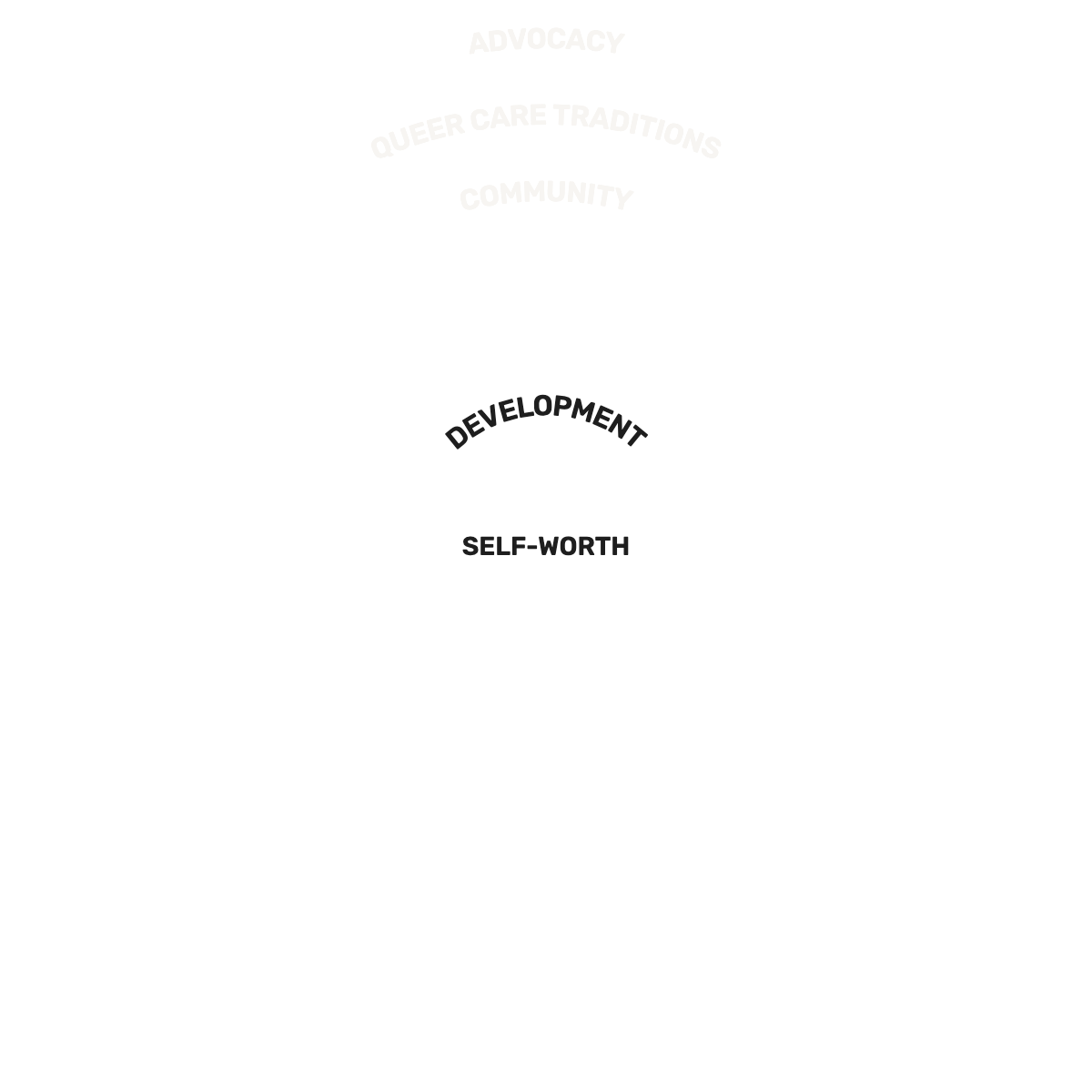
Six components hold the same person at once, from the work we do within to the systems around us. Together they rebuild a stable, self-compassionate sense of self.
Self-worth
Everything changes when our inner voice becomes an ally.
Gender-affirming care is about more than reducing distress. It helps transform our relationship with ourselves so self-worth, rather than shame, becomes the foundation for everything that follows.
Development
Our earliest relationships shape how we come to know ourselves.
Our sense of self develops through early relationships, lived experiences, and the messages we receive about who we’re allowed to be. Understanding these patterns helps us make sense of the beliefs we carry today.
Repair
Healing begins by changing the relationship with ourselves.
Relational wounds often become beliefs about being wrong, too much, or unworthy. Through inner child work, reparenting, and self-compassion, repair helps build a more stable and authentic sense of self.
Therapeutic Relationship
The therapeutic relationship as a corrective experience.
An affirming therapeutic relationship offers a new experience of being seen, understood, and accepted. Over time, that relationship can help reshape the patterns that once formed in the absence of safety and connection.
Community
Connection is a form of care, not just companionship.
Connection with peers, chosen family, and affirming communities creates belonging where isolation once existed. Healing deepens when our identity is witnessed, supported, and celebrated with others.
Queer Care Traditions
We inherit generations of care, not just generations of struggle.
LGBTQ+ communities have always had ways to care for one another when families, healthcare, and institutions failed to do so. Through chosen family, mutual aid, and community-born care, we inherit generations of wisdom that continue to shape healing today.
Advocacy
Care challenges the systems, not just the symptoms.
The distress people carry is systemic, not only personal. Grounded in Just Practice, Liberation Health, and queer care traditions, advocacy becomes part of treatment because healing also means changing the conditions that cause harm.
Guiding the work
Identity Exists on a Spectrum
We live in a binary culture that often limits the expansiveness that is the human spirit. Move beyond either/or thinking and explore how different dimensions of identity exist along a continuum rather than within fixed categories.
Female is a marker assigned at birth from a quick look at genitals, naming it, not a fixed truth.
Bodies hold more variation than two boxes can, hormones, chromosomes, and anatomy all differ.
Intersex bodies are natural and common, roughly as often as red hair, never a disorder.
The label given at birth marks one moment, it was never a map of the whole person.
Male on a certificate is a guess made for you, binary sex sorting is cultural, not universal.
Attraction to the same gender is one whole, healthy orientation among many, never a lesser one.
For many, desire crosses more than one gender, or shifts across a life, and stays valid.
Bisexual, pansexual, and asexual are complete orientations, not phases or confusion.
Orientation is about who draws you, not how you look, act, or are read by others.
Attraction to a different gender is common, yet it is one option, not the natural default.
Cisgender, identity matching the sex assigned, is one experience of many, not the measure.
Gender is often known deep within long before it is ever named aloud to anyone.
Transgender and nonbinary people are real and self-defining, honored across many cultures.
Identity is who a person knows they are, whatever others assume when they look.
Being a cis man is one point on the spectrum, never its endpoint or its norm.
Femininity is policed hardest on bodies not expected to carry it, a rule, not a nature.
Expression can lean one way today, another tomorrow, and be fully real at each turn.
Expression need not resolve into one box to be valid, ambiguity is a place to live.
How a person dresses or moves is language, not proof of their gender or desire.
Masculinity is boxed into a narrow look by society, though it has always been plural.
Guiding the work
Regulation Starts by Naming emotions
Most of us get by on a few blunt words for how we feel, but “fine” and “bad” only take us so far. The Feeling Wheel opens six core emotions into more precise vocabulary, because a feeling we can name is one we can start to understand, embody, and express to others.
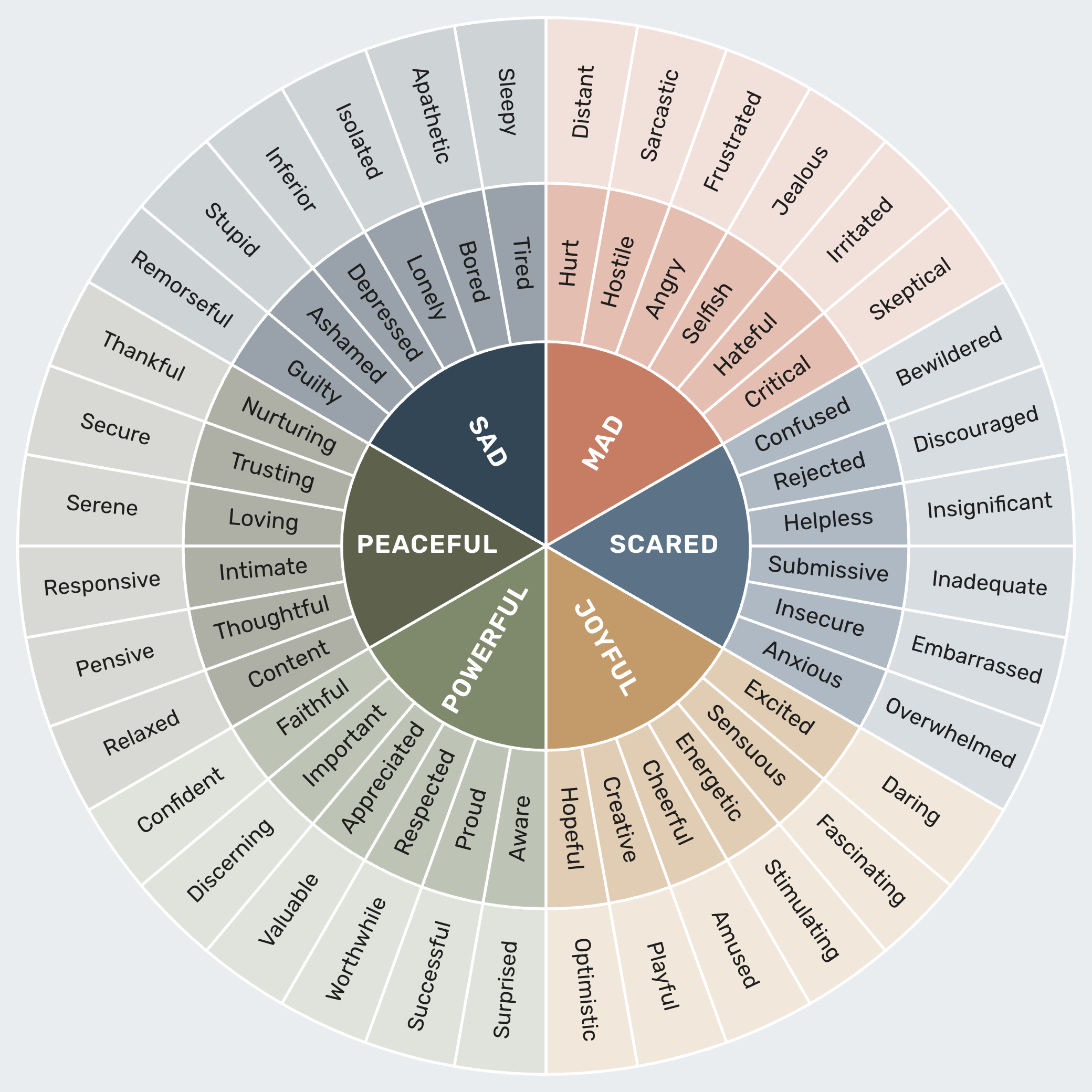
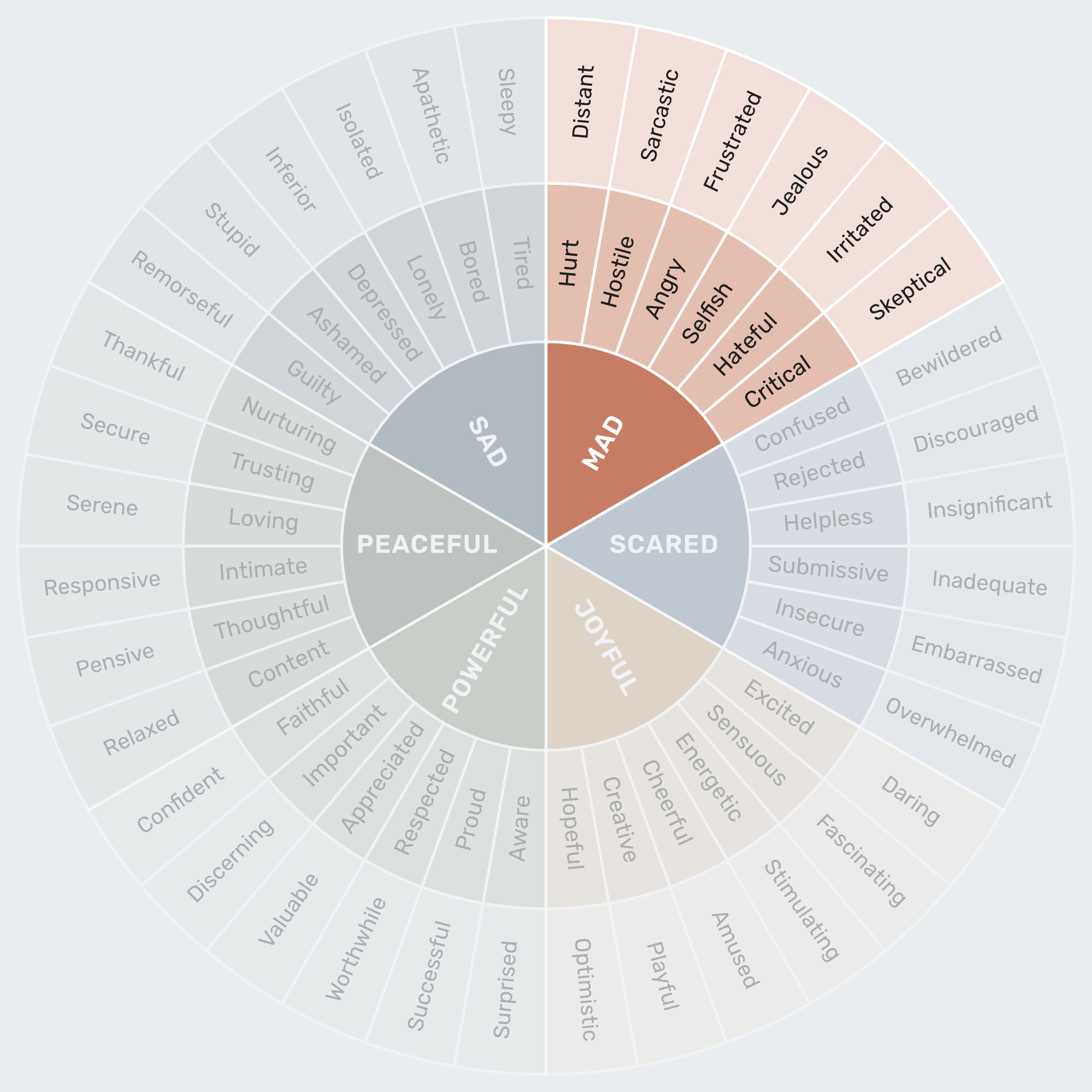
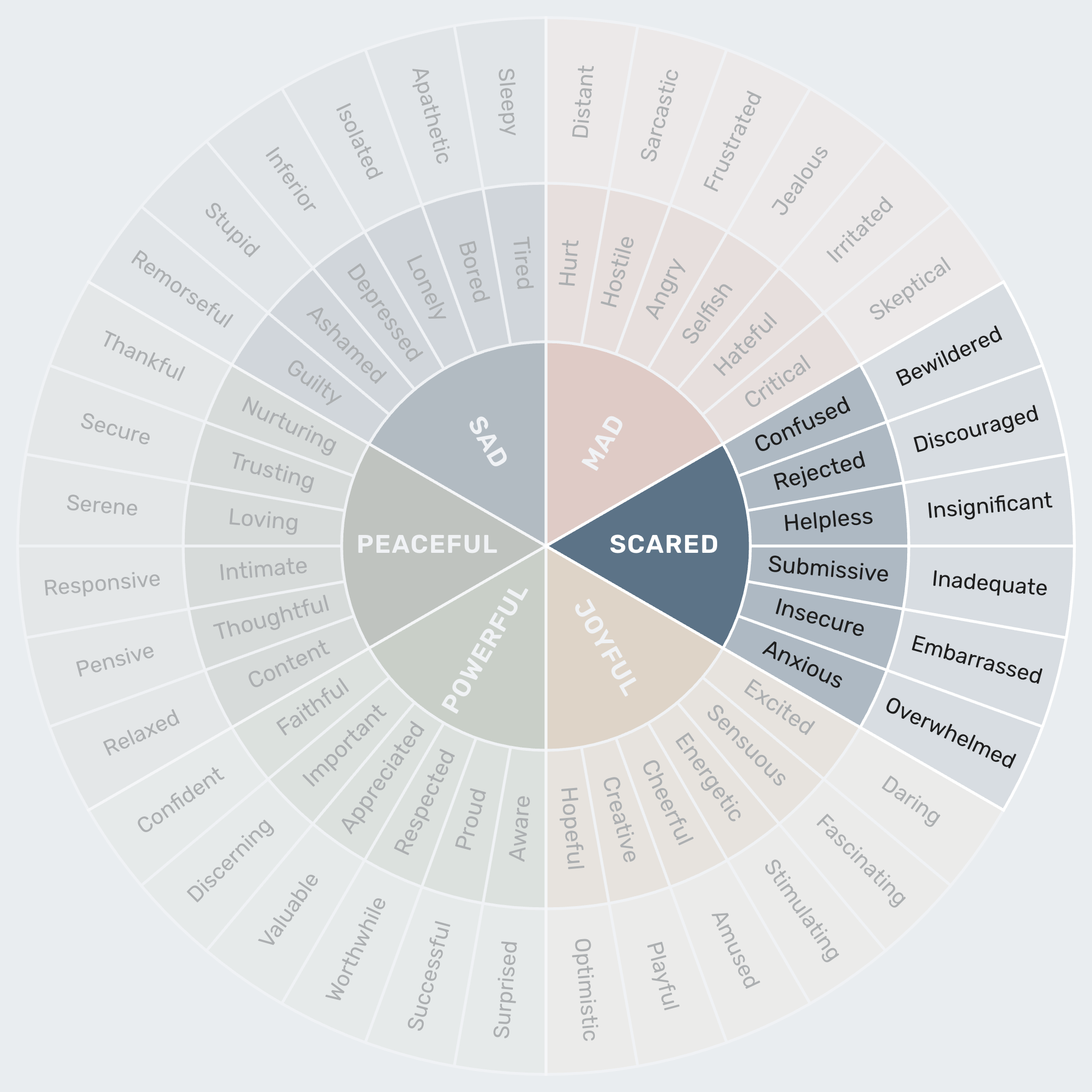
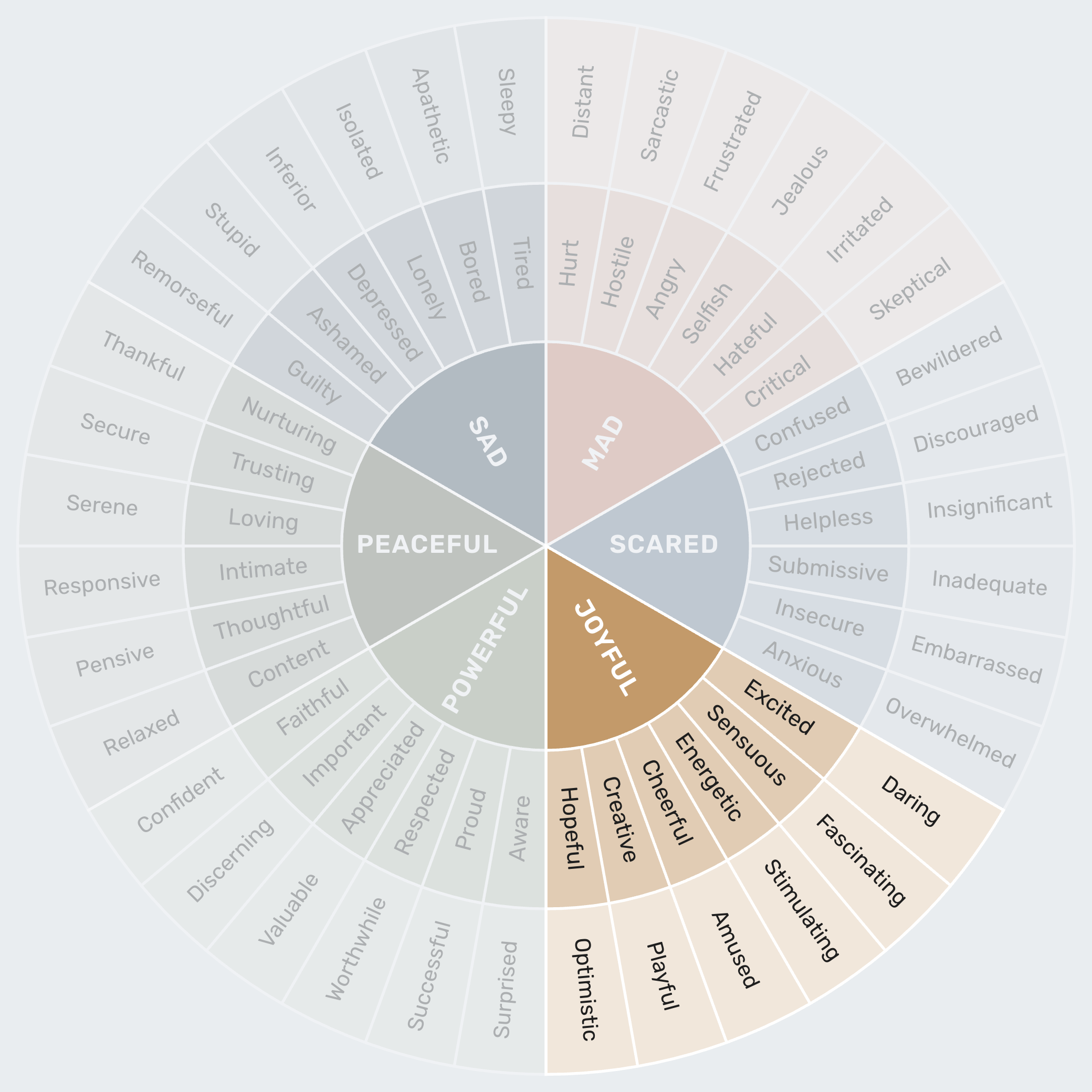
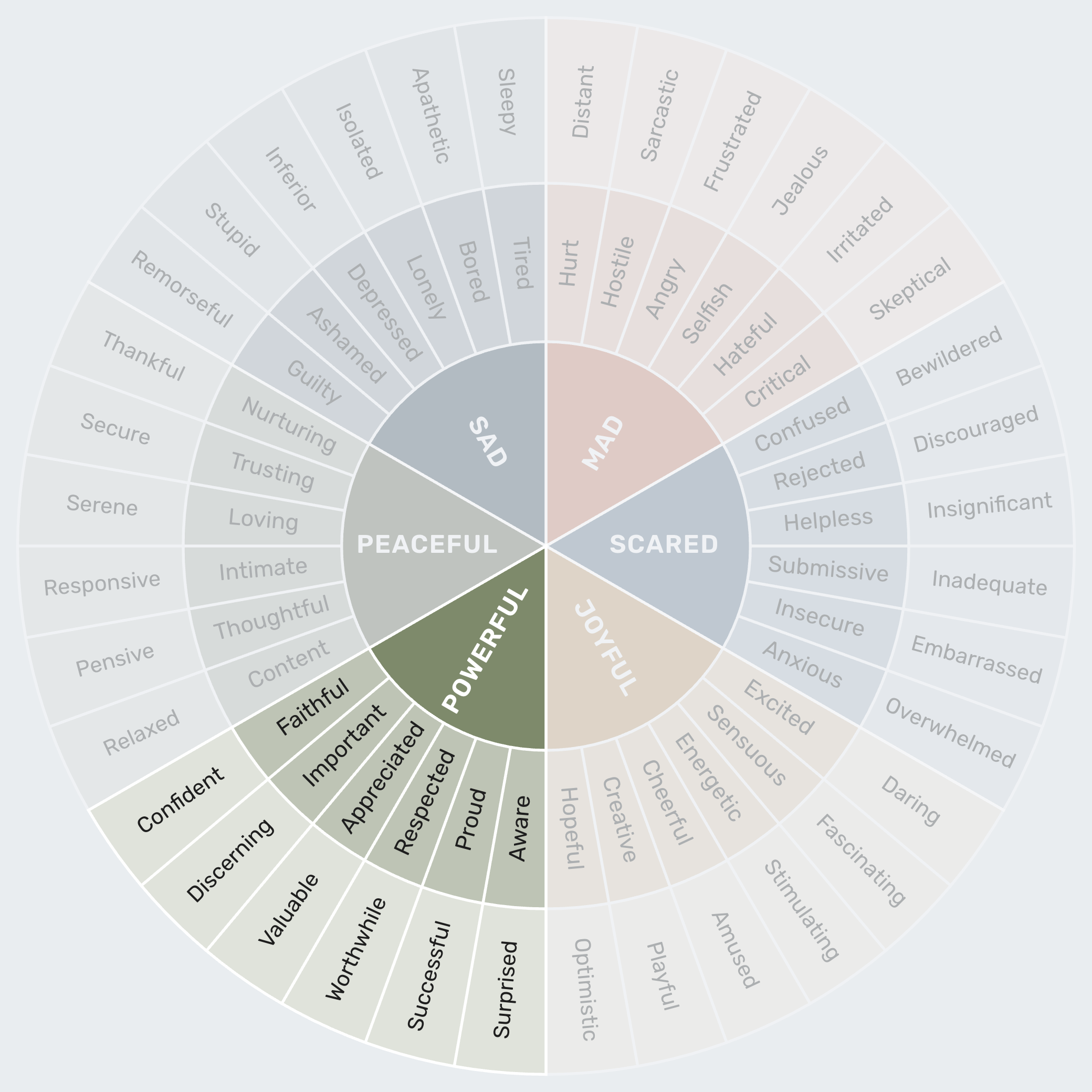
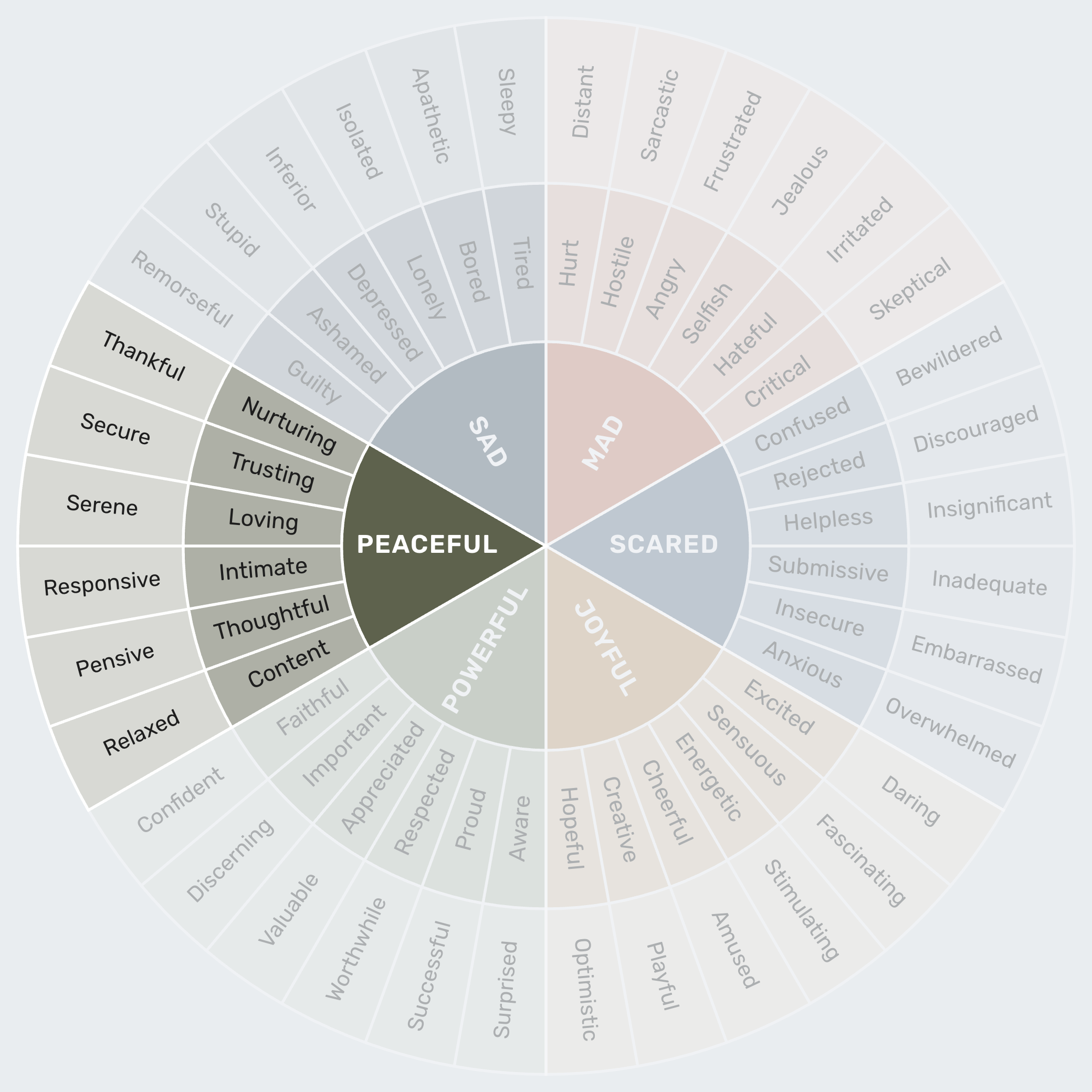
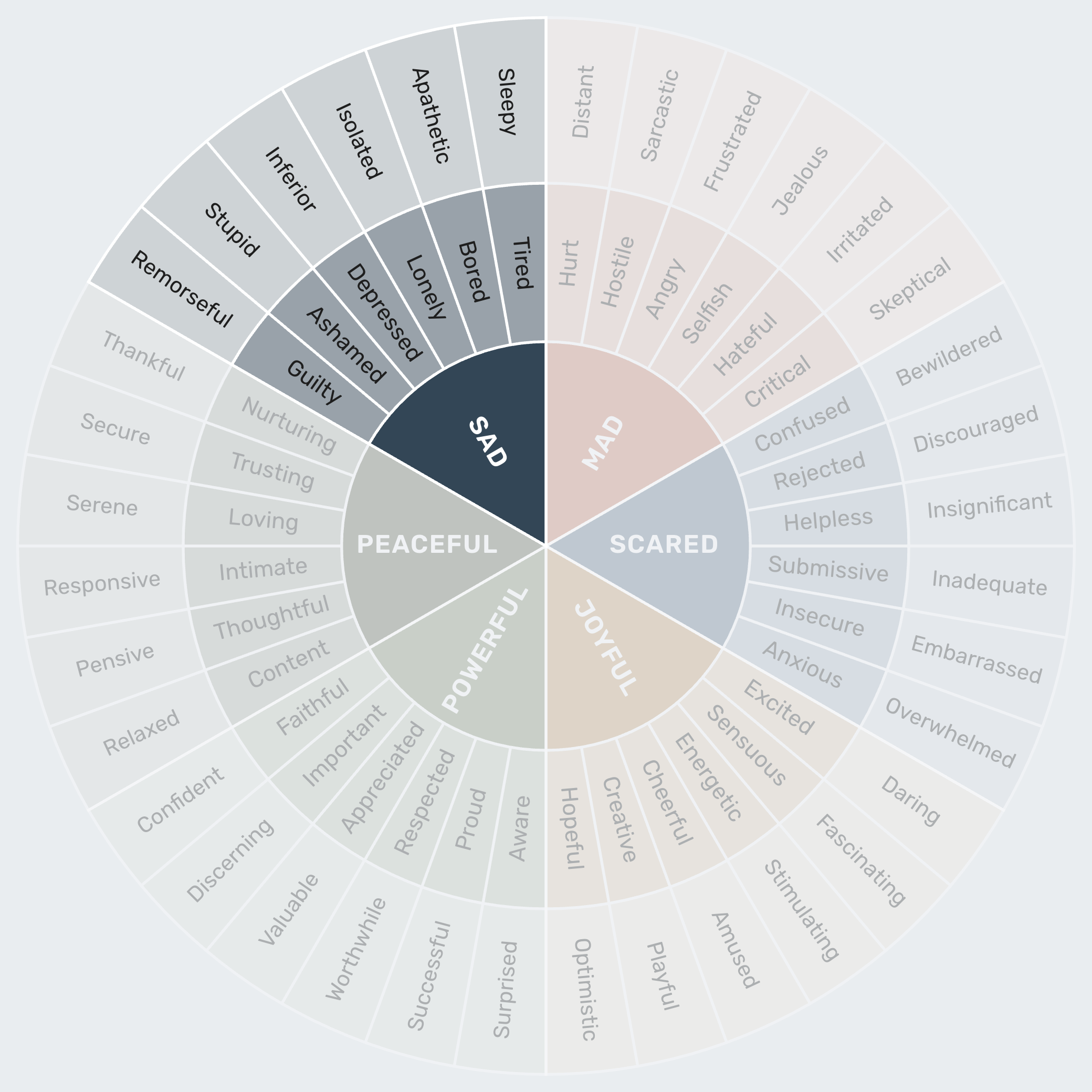
Tap the color family that feels closest, even if the word is not exact. The wheel opens that family into more precise words.
Mad→Scared→Joyful→Powerful→Peaceful→Sad→Six shades of mad. Which is closest?
Six shades of scared. Which is closest?
Six shades of joyful. Which is closest?
Six shades of powerful. Which is closest?
Six shades of peaceful. Which is closest?
Six shades of sad. Which is closest?
Adapted from Gloria Willcox, “The Feeling Wheel,” Transactional Analysis Journal (1982). There is no wrong answer here, and feelings from different families can be true at the same time.
Areas of Exploration
How We Can Work Together
No one arrives here with it all figured out, and you don’t have to. More often it’s a sense that something isn’t working, or a part of themselves they’ve never had room to look at. We go at your pace and make room for whatever you’ve been holding alone.






We start with who you are, and with the experiences that taught you to see yourself that way.
You learned your harshest beliefs about yourself somewhere, and we look at where.
You bring patterns into closeness, and we work on the ones you want to do differently.
We make sense of what happened to you, at a pace you set.
Something is driving the exhaustion, and we find it together with what actually helps.
The policies and conditions putting you at risk are real, and naming them is part of the work.
guiding the work
The Four Agreements
The Four Agreements by Don Miguel Ruiz has profoundly influenced both my personal life and my work as a therapist. It’s ancient wisdom that offers four simple principles for cultivating self-awareness, compassion, and healthier relationships. While these ideas are not a substitute for therapy, they are a valuable tool for reflection and growth, one that I often return to myself and invite others to consider on their own journey.
Guiding the work
self psychology: Core developmental Needs
When we develop our sense of self, Self Psychology identifies three essential needs: Mirroring, Twinship, and Idealization. Too often, queer and trans children are denied these affirming experiences, resulting in the low self-esteem and poor mental health.
Mirroring
Encouragement that helps a person feel seen, valued, and understood. Without it, many TGNC adults continue believing the person they are is wrong.
Twinship
The feeling of belonging and knowing you’re not alone. Without it, many TGNC adults continue hiding parts of themselves to feel accepted or safe.
Idealization
Connection to a trusted person who reflects hope and possibility. Without it, many TGNC adults struggle to imagine a future where they can fully thrive.
Fragmented
Forming
Cohesive
The self
Select a need to see what it holds.
Partly held. A self can carry one or two, but the gap stays open.
All three met, self-esteem forms.
Recognition is the intervention
Kohut, 1977 · Miliora, 2000 · Wright, 2021
guiding the work
How we reach or pull away
Our attachment styles are rooted in anxiety, how much we fear losing connection, and avoidance, how much distance we keep to feel safe. Put those two together, and we get four behavior patterns. Tap any quadrant to see one from the inside.
Attachment styles can change
We move between styles
No attachment style is fixed. Most of us recognize more than one, and where we land shifts with stress, history, and company. Because these styles are learned in relationship, steady, safe relationships can move us toward security over time, a shift known as earned security.
Low anxiety · low avoidance
Secure
Closeness and independence both feel available to us. This usually grows from early care that was mostly consistent and attuned, so reaching out worked. We ask for support directly, trust that people show up, and settle again after conflict.
High anxiety · low avoidance
Anxious
This pattern often grows from care that was there sometimes and gone others, so we learned to watch closely and hold on hard. Closeness matters deeply, so does the fear of losing it, and we scan for distance and seek reassurance to feel safe.
Low anxiety · high avoidance
Avoidant
This pattern tends to form when our needs were met with distance or discouraged, so we learned early it was safer not to need much. Independence feels safest, so we turn our needs down and handle things alone. It is not coldness, it is a strategy.
High anxiety · high avoidance
Disorganized
This pattern usually forms when the person we needed for safety was also a source of fear, so no single strategy ever worked. Closeness becomes both longed for and dangerous, so it is push and pull, reaching in and then pulling back to stay safe.

Did You Know?
Tid Bits To Take With You
A few ideas worth carrying into the room, drawn from research and from clinical judgment.
The distress is a response, not the identity.
What clinicians see in LGBQ+ and TGNC clients is largely a response to stigma and discrimination, and that distinction changes what good care looks like.
Meyer, minority stress model (2003)

Affirming care isn’t only ethical, it’s effective.
It is associated with lower depression, anxiety, and suicidality when clients can actually access it.
SAMHSA (2024)

Finding a competent provider is itself a barrier.
Difficulty finding an affirming clinician is one of the biggest documented obstacles to care.
SAMHSA, Behavioral Health Care Access Among LGB Populations (2024)
It’s a training gap, not a willingness gap.
Lack of formal training is one of the largest limits on affirming care; most clinicians were never trained for it.
Lee & Rosenthal, Annual Review of Medicine (2023)

Ignoring context isn’t neutral.
A decision that leaves out a client’s family, school, law, and community is one made with missing information.
From your Structural Context domain

The act isn’t what separates a crossing from a violation.
A boundary crossing and a violation can look identical from outside; what differs is who it serves, the client or the clinician.
From the framework, reinforces the Core Distinction block
Ethics codes give you the floor, not the answer.
The hardest decisions live in the space a code can’t resolve, which is what clinical judgment is for.
From the framework, NASW ethics + clinical judgment
Reviews
What Clients Say About Our Work
Feedback is a welcomed part of the process. We shape the experience together through practicing open communication.
As a trans woman, I had a lot of fear about finding an accepting therapist based on some horror stories from my past. Kris was patient, gentle, and consistent, allowing us to build trust I hadn’t felt with a provider before.
G
Georgia, 32
Gender Identity Exploration
It’s honestly exhausting having to explain basic gender-diverse identity to professionals I’m paying for help. Previous terrible experiences made me nervous to try again, but with Kris, I felt understood right off the bat.
M
Max, 26
Transition Support
I thought the trauma I had experienced was in the past, but Kris helped me see that those moments were still with me, stuck, and getting activated on the surface which helped me target my actual issues.
M
Michael, 47
Trauma & Depression
Resources
Resources for Every Stage of the Journey
Whether you’re a young person, caregiver, educator, or clinician, these resources are designed to help you find support, understanding, and next steps.

Individuals
Resources for individuals exploring identity, seeking affirming support, and finding their own path toward wellbeing and understanding.
Explore Resources →
Youth, Families & Schools
Resources for youth, families, and schools navigating mental health, identity, and belonging with affirming support and community care.
Explore Resources →
Clinicians & Organizations
Resources for clinicians and educators building affirming, identity-centered practice from clinical frameworks to continuing education.
Explore Resources →
