SERVICES
School & Community Support
Affirming workshops, consultation, and guidance that help schools build communities where LGBQ+ and TGNC students belong.
School Communities
Supporting The Whole School Community
Creating an affirming school climate isn’t the responsibility of one person or one department. It grows through the everyday actions of the people who shape a student’s experience, both in school and at home.

01 The StudentThe person at the center of every decision.
02
 Teachers & StaffThe adults who shape daily belonging.
03
 School LeadershipThe people building the culture and systems.
04
 Caregivers & FamiliesThe relationships connecting school and home.
Gender-Affirming Care
Belonging Is Built Every Day
Not a sequence and not a spiral, six relationships holding one person at the same time. Open any one to see the work it does.
Areas of Exploration
How I work with School communities
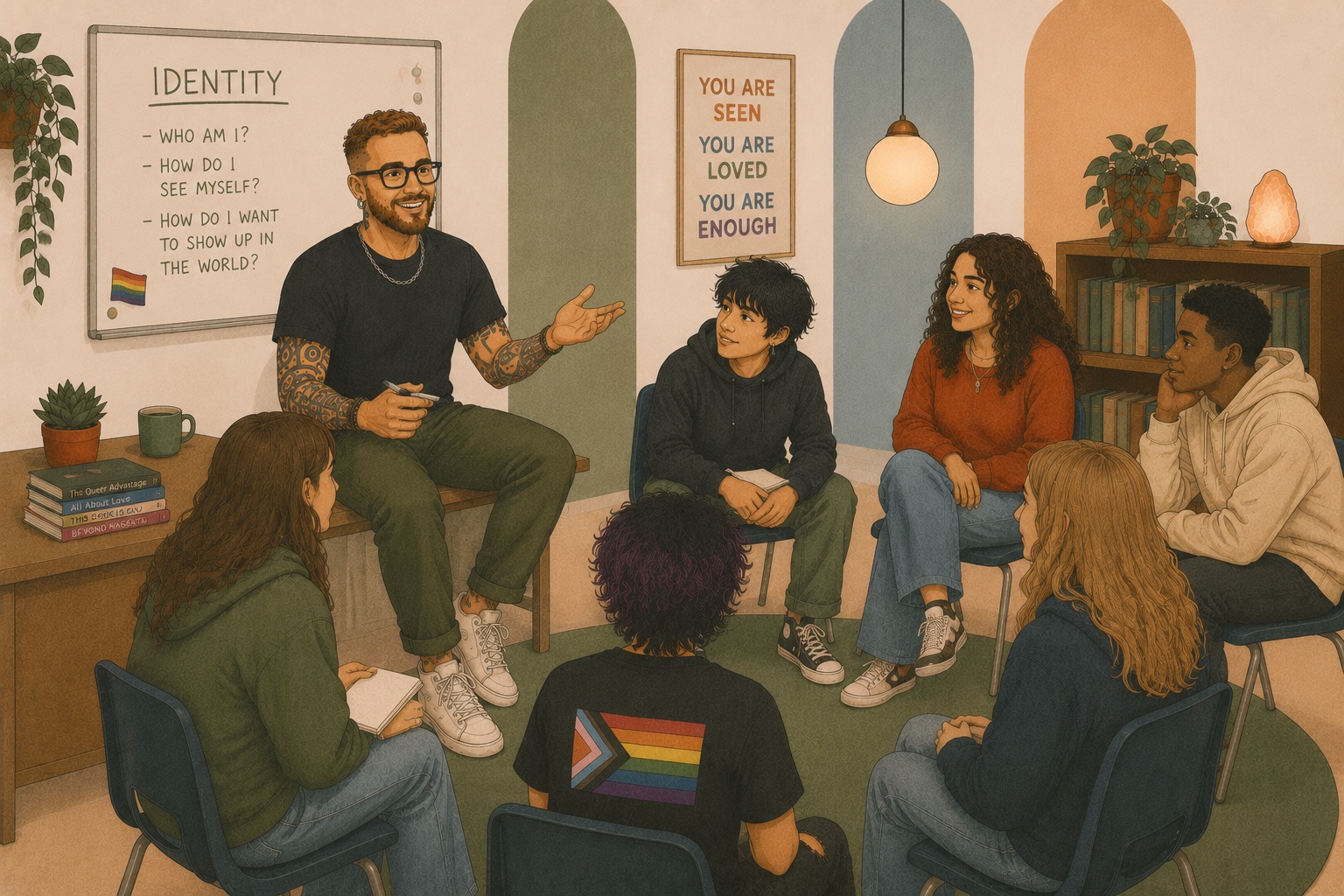
I have yet to walk into a school community where the adults didn’t care. What’s usually missing is the language, the practice, and the room to get it right. That is what we work on together.






I work directly with the students who need a trusted adult in the building.
We build language and classroom practice that reflect the students actually in the room.
I give you practical footing on names, pronouns, and what changes as a student’s needs do.
Caregivers get the words for the conversations they are afraid to start.
Teachers get knowledge they can use the next morning, including for the hard situations.
Rules are the easy half. We work on the culture that decides whether anyone follows them.
A Day in the Life
The Impact of Cultural Transphobia
For queer and trans kids, cultural transphobia moves through every layer of their life, from personal relationships to community norms to state policy. Understanding how it operates allows us to recognize the harm as structural, not personal, and respond accordingly.
Micro · Home, body, inner world
Micro is the closest layer, home, body, and inner world. It is where transphobia is felt most personally, in who names you and whether you feel safe being known.
Meso · Schools, healthcare, sports, city
Meso is the institutions a young person moves through, school, healthcare, sports, city. Its rules decide who gets a bathroom, a team, or care, and who is left out.
Macro · Laws and cultural narratives
Macro is the outermost layer of laws and cultural narratives. It sets the climate every other layer breathes in, giving harm permission before it reaches a kid.
MORNING
MICRO · HOME
- Misgendered & deadnamed
- Called a freak & “going to hell”
- No “masculine” clothing
- Surveillance & isolation
THE SCHOOL DAY
MESO · SCHOOL
- No gender-neutral bathrooms
- Banned from team sports
- Bullied & slurred
- Deadnamed & misgendered
OUT IN THE CITY
MESO · CITY
- Barriers to affirming care
- ICE presence at airports
- Public misgendering
- Program cancellations
THE CLIMATE OVERHEAD
MACRO · FEDERAL
- “Two genders” declared
- Identity criminalized
- Activists cast as threats
- Care access rolled back
CARRIED WITHIN
MICRO · INTERNAL
- Internalized transphobia
- Body & gender dysphoria
- Low self-worth
- Shame, fear & self-harm
guiding the work
Childhood Development: Three Core Needs
When children develop their sense of self, Self Psychology identifies three essential needs: Mirroring, Twinship, and Idealization. Too often, queer and trans children are denied these affirming experiences, resulting in the low self-esteem and poor mental health.
When it failsWhen it’s met
MIRRORING
Affirmation and encouragement that helps a young person feel seen, valued, and emotionally understood.
When denied at home, TGNC youth learn that the self they know is not one they can show.
One adult who uses their name and pronouns without conditions reflects worth back, and TGNC youth get mirrored where home refuses to.
TWINSHIP
The experience of sameness, belonging, and not feeling alone in who you are.
Without it, TGNC youth conceal and monitor safety constantly, and anticipating disbelief becomes its own daily labor.
With it, through chosen family, peers, and clinicians who share their identity, TGNC youth stop explaining their existence and are simply understood.
IDEALIZATION
Connection to a healthy adult model that is experienced as safe, admired, or aspirational.
With trans adults under attack, TGNC youth have few role models to look toward as evidence of a future available to them.
Trans elders and mentors make a future visible, and TGNC youth get a life they can picture rather than one they must imagine alone.
Repeated across home, school, medicine, and policy, these failures stop being individual and become cultural transphobia, a society-wide empathic failure that produces relational deprivation, a chronic absence of recognition, affirmation, and belonging at scale.
An affirming adult can function as a reparative selfobject, meeting the developmental need the system failed to meet. This is why the CARE Framework treats recognition as clinical action rather than kindness.
Kohut, 1977 · Miliora, 2000 · Meyer, 2003 · Wright, 2021
guiding the work
The four Attachment styles, mapped
This map lays out the four styles by anxiety, how much we fear losing connection, and avoidance, how much distance we keep to feel safe. None of us sits neatly in one corner. Tap any style to see where it falls and how it moves.
How to read the map
We each fall somewhere in between
Each attachment style has a corner, placed by how high or low it runs on anxiety and avoidance. A real person is rarely all one thing, so we read where someone falls between the corners. The farther from center, the harder that strategy is working.
At ease, close or apart
Secure
Low anxiety, low avoidance. This usually grows from early care that was mostly consistent and attuned, so reaching out worked. Closeness and independence both feel available, so we can ask for support, offer it, and settle after stress.
Reaching to cling on
Anxious
High anxiety, low avoidance. Often shaped by care that came and went, so we learned to watch closely. Closeness matters deeply, and so does the fear of losing it, so our system runs hot, scanning for any sign of distance and seeking reassurance.
Keeping a safe distance
Avoidant
Low anxiety, high avoidance. Often shaped by needs being dismissed or discouraged early, so not needing felt safer. Independence feels safest, so we turn our needs down low and keep closeness at a workable distance, handling most things on our own.
Pulled both ways
Disorganized
High anxiety, high avoidance, and the furthest from the secure corner. This usually forms where the person we needed for safety was also a source of fear. Closeness is both longed for and feared, so the pattern is push and pull at once.

Did You Know?
Tid Bits To Take With You
A few ideas worth considering, drawn from research and from the people who have lived it.
Belonging is a developmental need.
For LGBTQ+ students, school belonging is the felt sense that there are others like me, and it shapes development.
Goodenow, 1993; Kohut, 1977
One supportive adult moves the needle.
One supportive adult measurably raises LGBTQ+ students’ belonging and lowers depressive symptoms.
Dessel et al., 2017; Ancheta et al., 2021

One visible signal says you’re safe.
A sticker, a pronoun on your name tag, or an inclusive line in class tells students you are safe.
Kosciw et al., 2022; Ancheta et al., 2021

You may be the adult they lack at home.
Being that affirming adult for a student is protective, and sometimes lifesaving.
Dessel et al., 2017; Wright, 2021
Backing a GSA is high-yield.
GSAs and affirming clubs give students community, and backing them is one of the highest-yield moves a school can make.
Toomey et al., 2018; Ancheta et al., 2021
Naming harm is what shifts the climate.
Trans students face elevated bullying. Interrupting it, rather than ignoring it, is what changes the climate.
Johns et al., 2019; Toomey et al., 2010
Explore My Work
Building Strong School Communities
Explore examples of workshops designed to help caregivers, educators, and school communities build confidence, strengthen relationships, and better support LGBTQ+ and TGNC youth.
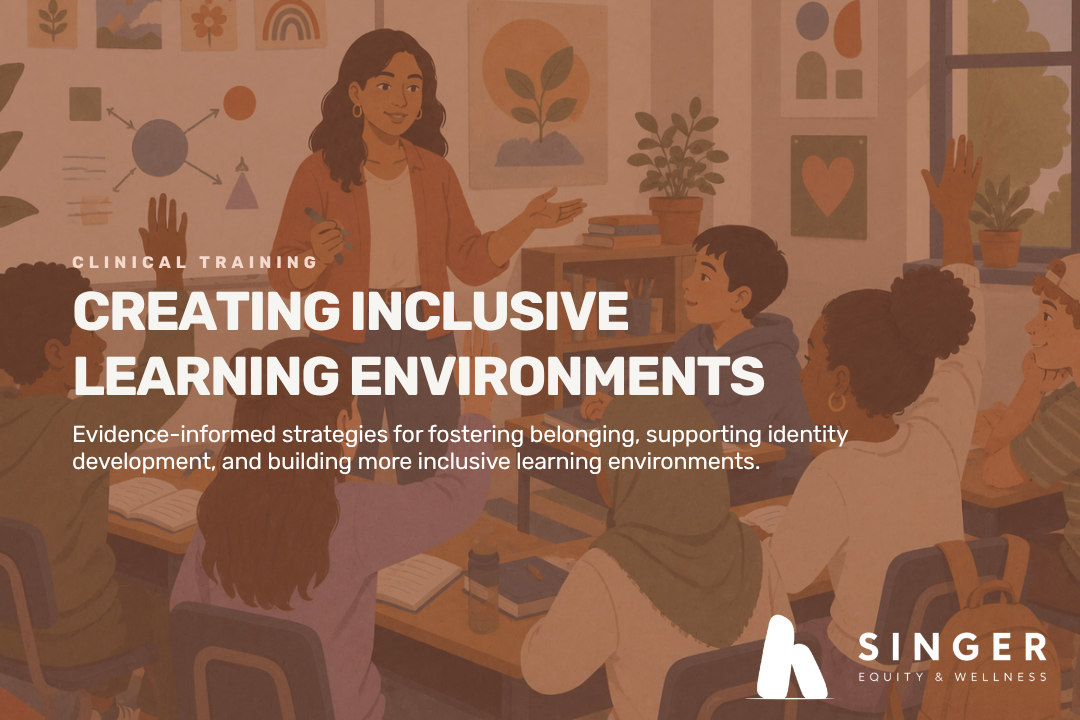
For Educators
Creating Safer, More Inclusive Learning Environments
Practical tools to foster belonging and build classrooms where every student can thrive.
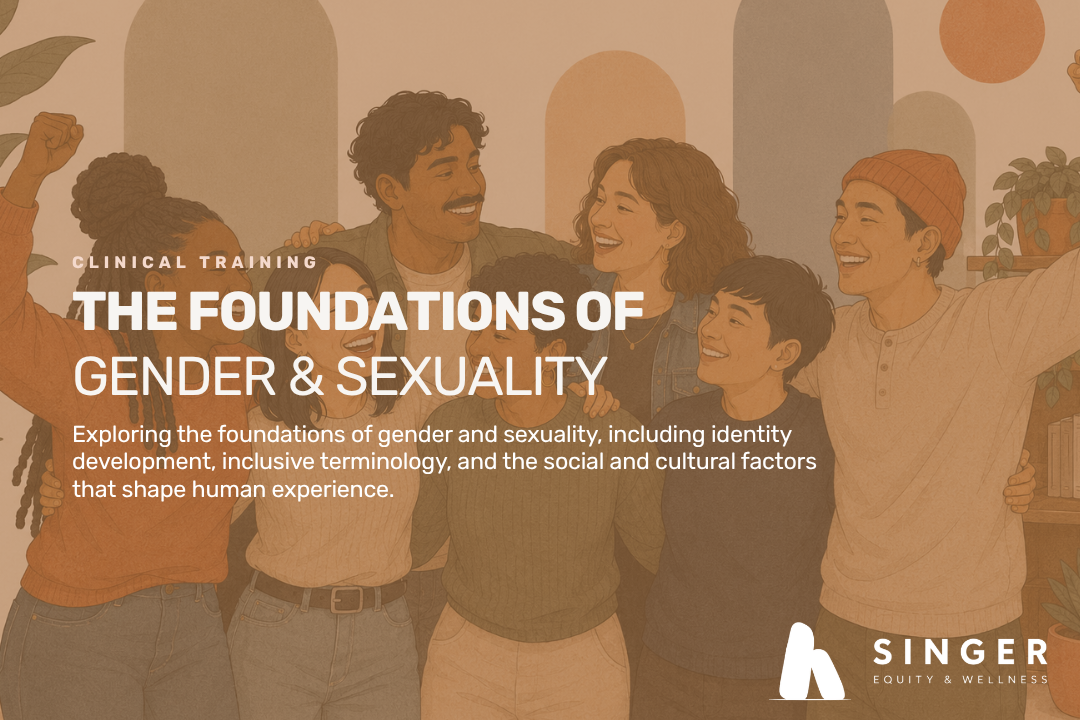
Foundations
The Foundations of Gender & Sexuality
An accessible introduction to key concepts, terminology, identity development, and affirming practices.
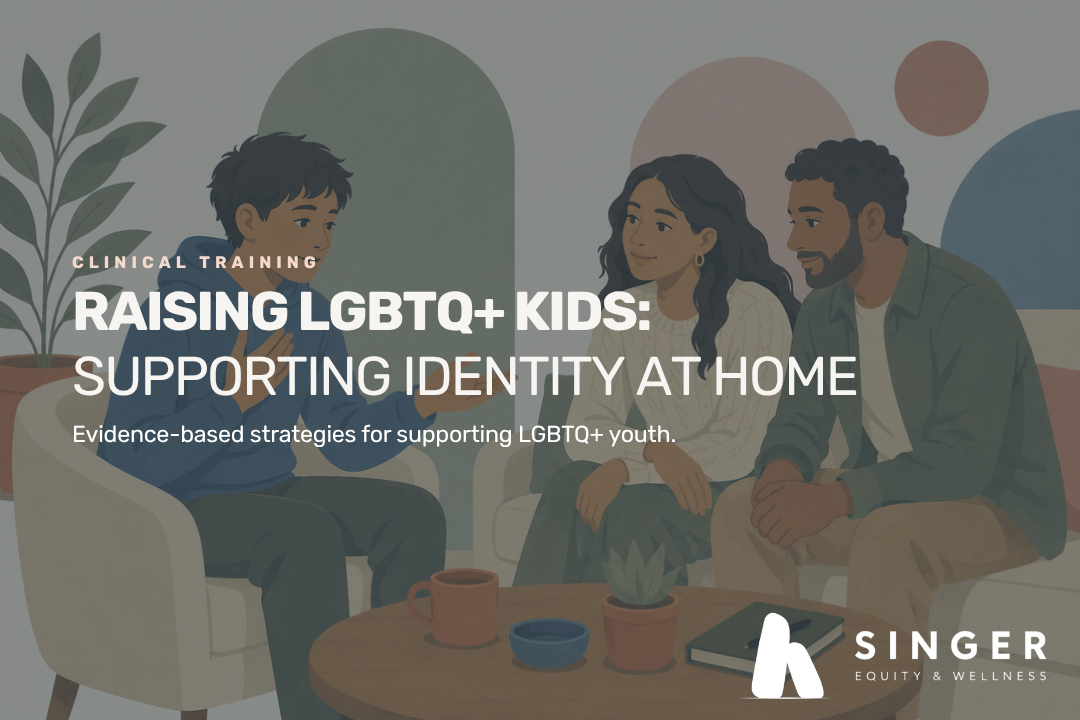
For Caregivers
Raising LGBTQ+ Kids: Supporting Identity At Home
Evidence-based strategies for supporting LGBTQ+ youth while strengthening communication and building trust.
Thinking Out Loud (And Proud)
A collection of essays, frameworks, and evolving ideas drawn from my clinical practice, community work, research, and lived experience.
-
Gender-Affirming Care Is Relational Care
-
Reframing Ethics Through Trans Eldership: The CARE Framework for Clinical Judgment in Gender-Affirming Care
-

What Self Psychology Can Teach Us About Gender-Affirming Care
-

Using The Four Agreements To Support Healing
-

Queer & Trans Youth Are Under Attack & They Need Our Help
-
The Role Of Practice Wisdom & Clinical Judgment In Gender-Affirming Care
Reviews
What School Communities Say About Our Work
Feedback is a welcomed part of the collaboration process. We shape the experience together through practicing open communication.
Steve Collins
Student Parent · High School of Art & Design, NYC
Kim Tannen
Health Teacher · High School of Art & Design, NYC
Michelle Daly
Assistant Principal · High School of Art & Design, NYC
When our child came out, we wanted to be supportive but honestly didn’t know where to begin. Kris never made us feel judged for not having answers. They helped us understand what our child needed, and our relationship is stronger because of it.
S
Steve Collins
Student Parent · High School of Art & Design, NYC
Kris helped make conversations about identity feel approachable rather than intimidating. They co-facilitated lessons, supported our LGBTQ+ student group, and gave our staff practical ways to create classrooms where students felt seen, respected, and safe enough to learn.
K
Kim Tannen
Health Teacher · High School of Art & Design, NYC
Kris embedded in our high school and quickly became someone our students wanted to be around. They gave our staff practical tools and met our families with real warmth. Our whole school community is stronger for having them.
M
Michelle Daly
Assistant Principal · High School of Art & Design, NYC
Resources
Resources for Every Stage of the Journey
Whether you’re a young person, caregiver, educator, or clinician, these resources are designed to help you find support, understanding, and next steps.

Individuals
Resources for individuals exploring identity, seeking affirming support, and finding their own path toward wellbeing and understanding.
Explore Resources →
Youth, Families & Schools
Resources for youth, families, and schools navigating mental health, identity, and belonging with affirming support and community care.
Explore Resources →
Clinicians & Organizations
Resources for clinicians and educators building affirming, identity-centered practice from clinical frameworks to continuing education.
Explore Resources →
