
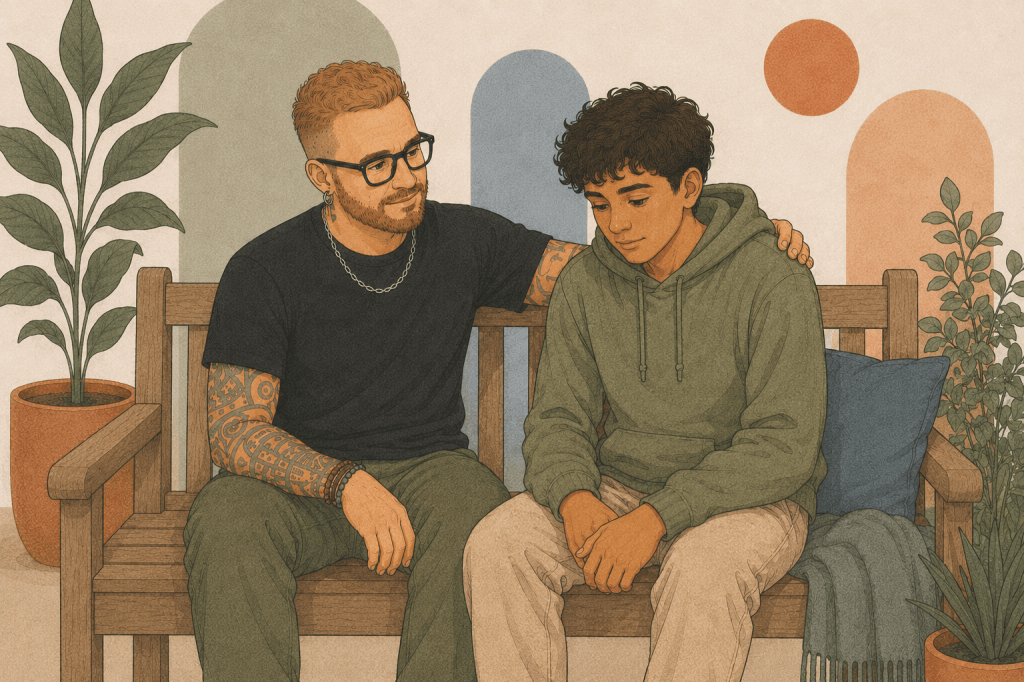
Gender-Affirming Care Is Relational Care
Introduction
A client I’ll call Tara first came to me at twenty-six, and for most of the first month she apologized in nearly every session, for crying, for taking up time, for not being “further along.” By every external measure she had made it. She was a trans woman who was out, employed, housed, and partnered. And underneath all of it she carried a certainty that lived in her mind: that she was too much and not enough at the same time, and that if people ever really saw her, they would leave. She had learned that lesson early and thoroughly, and no amount of external success had ever touched it.
Nothing was ever wrong with Tara. What was wrong was everything that had taught her to believe those things, and everything that kept reinforcing it still. That gap, between what is wrong with a person and what has happened to them, is where much of my model of care lives.
The Distress Is Not The Identity
The most important thing I can say about gender-affirming care is also the most misunderstood. The depression, the anxiety, the shame a client like Tara walks in with are not symptoms of being trans. They are the predictable result of moving through a world that withholds recognition and acceptance. Ilan Meyer’s (2003) minority stress model showed this was measurable decades ago: the elevated rates of distress in queer and trans populations are produced by chronic exposure to stigma, prejudice, and discrimination, not by anything intrinsic to the identity itself. The problem was never the person; the problem was the conditions.
This is why I get uneasy when gender-affirming care gets talked about only as a set of techniques: the right pronouns, a letter for hormones, a referral down the line. Those things are crucial, and I do them without hesitation, but they are the paperwork around the care, not the care itself. The wound underneath is relational, made of everyone who failed to see the person clearly. What was wounded in relationship has to be healed in relationship.
Healing Was Never A Solo Act
Developmental theory tells us why. Heinz Kohut’s Self Psychology describes how a stable, whole sense of self is built, not alone, but through relationships he called selfobject experiences: being mirrored, so you feel seen and valued; having someone to idealize, a steady figure to look toward; and twinship, the felt sense that there are others like you, that you are not the only one. For many of us who grew up queer or trans, those experiences were missing or actively withheld, and the gender socialization that starts the moment a child is sorted into pink or blue taught us that the self we knew was not one we were allowed to show. When mirroring and twinship and idealization are denied, the self forms around the absence. That absence was Tara’s whole inheritance.
Here is the part institutions tend to forget: queer and trans communities have never waited to be rescued; when families, clinics, schools, and governments failed us, we built our own systems of care. We created chosen families, ballroom houses led by trans mothers and fathers, mutual aid, and networks of eldership that mentored the next generation into a livable life. Anthropologist Kath Weston documented this decades ago as “families we choose”. Care, for us, has always been something collectively generated. My work is not to invent that. It is to bring it, responsibly, into the room as valid and necessary forms of intervention.
So the model I work from keeps one person at the center and asks what has to be repaired or rebuilt around them, and over time that question has organized itself into six pillars. Two of them are the work we do with ourselves, Development and Repair, while the remaining four can only happen in relationship with others: the Therapeutic Relationship, Community, Queer Care Traditions, and Advocacy. None of them is a stage a person finishes and leaves behind; they work together, at the same time, to rebuild self-worth.
The Work We Do With Ourselves
Development
Development can be the hardest part of the work, and often the slowest. It means going back into early childhood, into how the self was formed and where it was wounded: the first relationships, the gender assigned at birth, the messages about who a person was allowed to be. This is trauma work. We name the developmental needs that went unmet, and we trace how their absence hardened into the beliefs a person still lives by: that they are wrong, too much, or unlovable. Facing that history is painful, and it cannot be rushed. For queer and trans folx, so much of it traces back to being handed a self that never fit. It’s harder for the other work to hold if this part is skipped.
Repair
Here we take up those same beliefs, no longer to trace where they came from but to begin the slow, patient work of healing them. In practice that is inner child work and, often, reparenting: offering a younger self the steady, attuned care it needed and did not get, until self-compassion can begin to stand where shame has been. Kristin Neff’s research is clear about the pattern: meeting your own pain with warmth rather than judgment is associated with real reductions in shame. With Tara, this was slow. For a long time the kindest voice in her life was one she borrowed from me, until, eventually, it started to sound like hers.
The Work That Can Only Happen With Others
Therapeutic Relationship
It is not the container for the work so much as the work itself. Nearly eighty years ago Franz Alexander named the “corrective emotional experience,” the idea that we heal by re-encountering an old relational injury under new and more favorable conditions, not through insight alone. Self Psychology sharpens it: in the room, I become, for a while, the mirroring or idealizing or twinship figure a client did not have, and every small moment is a chance to be that affirming presence (Wright, 2021). This is why psychotherapy research keeps landing on the same unglamorous finding: the strength of the relationship predicts whether therapy helps at all.
Community
No relationship inside a therapy room is meant to be the whole of a person’s belonging. Twinship, the felt sense that there are others like me, is where an enormous amount of safety and joy actually live. The evidence that it protects is not soft. Family acceptance predicts dramatically lower depression and suicidality in LGBTQ young people (Ryan et al., 2010), and access to even one affirming space or one accepting adult is tied to substantially lower suicide risk (The Trevor Project, 2025). Helping someone find their people is part of the treatment, not an errand after it. Tara’s turning point was not a session. It was a trans women’s group where, for the first time, she did not have to explain herself to be understood.
Queer Care Traditions
Healing includes knowing you come from a lineage of people who found ways to care for one another when no one else would. This part of the work is about restoring that inheritance to someone who was taught they had none. When a person can locate themselves in a long history of queer and trans survival, the story of their own life changes. They are no longer only someone to whom bad things happened, but an inheritor of resilience, and perhaps someday one who carries it forward. And lineage is not only a story we tell, it is a set of care practices we bring into the room. Those traditions carry forms of care that conventional practice never considers, or actively warns against. This pillar holds them as valid, and sometimes essential. When a transmasculine teenager cannot get a chest binder because his parents refuse, that piece of cloth is not a boundary to manage. It is lifesaving, and this pillar requires that we help him get it. To withhold that care in the name of professional caution is not neutral. This is where trans eldership lives.
Advocacy
When working with marginalized people, the distress is systemic, so leaving the systems untouched can keep people stuck no matter how much repair happens inside. To treat only the individual is, in the end, to ask them to adapt to conditions that should never have to be tolerated. So the work reaches past the session, into schools that refuse a name, families learning to show up, policies that decide who gets care, and the mutual aid that keeps people housed and fed when institutions will not. Frameworks like Just Practice and Liberation Health treat changing those conditions as clinical work, not as something separate from it. Sometimes the most therapeutic thing I can do is refuse to locate the whole problem inside my client, and say plainly that the problem is where it has always been.
What It All Moves Toward
None of this is aimed at symptom reduction. When these six pillars do their work, what they rebuild is what Kohut called a cohesive self, whole and durable, rooted in self-compassion instead of shame. Self-worth is the outcome, and in turn the engine, not a finish line a person crosses once but the ground everything else grows from. That is why I treat self-worth as the aim, not a side effect. A person who believes, underneath everything, that they are worth caring for can do what was impossible before: let people close without watching for the exit, sit inside a hard feeling and trust that it will pass, and begin to want a life rather than brace against one.
Tara is still my client and she still has hard weeks. But she does not apologize for taking up the hour anymore, and last month she told me, almost in passing, that she had started to believe she was someone worth knowing. That is the whole point. Not the absence of distress, but the presence of a self a person can actually like living inside, and build a life beyond survival from.
Why This Matters
Underneath all of it is a simple reframe. Gender-affirming care is not a procedure we perform on people. It is a set of relationships we help rebuild around them, and every one of those relationships points back to the same center: a person learning, often for the first time, that they are worth the care. This is also why the reframe reaches past any single session. So much of the world still treats the trans person as the problem to be managed, and care that accepts that framing, however gently, ends up agreeing with it. Naming the injury as relational puts the responsibility back where it belongs, on the conditions and not the person, and it asks the people and systems around that person to change too. The techniques matter, but the relationship is the intervention and it always was.
This piece draws on the theoretical grounding of my clinical work and research: Self Psychology (Kohut; Wright, 2021), Minority Stress Theory (Meyer, 2003), the corrective emotional experience (Alexander & French, 1946), scholarship on chosen family (Weston, 1991) and family acceptance and protective factors (The Trevor Project, 2025; Ryan et al., 2010), self-compassion research (Neff, 2011), and the Just Practice and Liberation Health traditions in social work. “Tara” is a pseudonym, and all identifying details have been altered.

